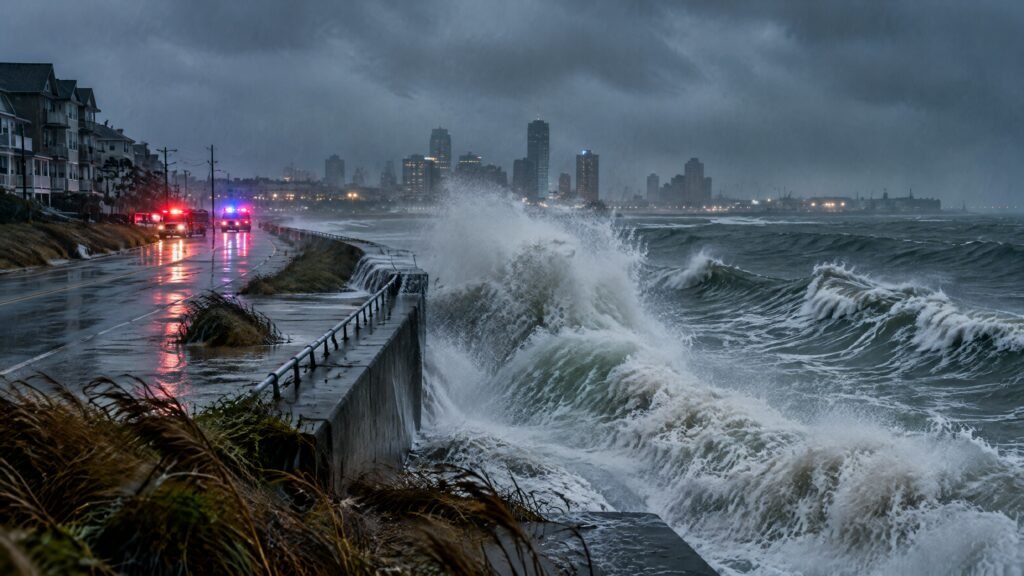
September 27, 2026 — A powerful early-season nor’easter is bringing heavy rain, damaging winds, coastal flooding and travel disruption to communities from the Mid-Atlantic to New England. Millions of people are in the storm’s path as officials warn that conditions can worsen around high tide.
What is happening along the East Coast?
CBS News reported that the storm intensified as it moved toward New England, producing storm-force winds and dangerous waves. Coastal flooding was expected across parts of New Jersey, Delaware, New York and New England, while emergency declarations and evacuation guidance were issued in some communities. Read the CBS News report.
CNN’s live coverage reported that one person had died and more than 90,000 customers were without power after trees and power lines were brought down. The report also said thousands of flights were delayed or canceled and Amtrak warned of disruptions on the Northeast route. Follow CNN’s storm coverage.
Flooding and wind remain the main risks
Some coastal locations had already received several inches of rain, while wind gusts reached 50 to 60 mph in southern New England. CNN reported that some areas could see additional heavy rain through Monday morning, and that flooding could return during the next high-tide cycle.
CBS News cited National Weather Service forecasters who said peak gusts could approach 60 to 65 mph on Cape Cod, Martha’s Vineyard and Nantucket, with lower but still dangerous gusts around Boston. Strong winds can bring down branches, damage structures and create extended power outages, especially while leaves remain on trees early in the fall season.
Communities respond as water rises
In New Jersey, some low-lying communities issued voluntary evacuation guidance. CNN reported that first responders rescued nine adults and a dog from flooded motel rooms in Egg Harbor Township; no injuries were reported in that rescue. Other coastal towns opened shelters or urged residents to move away from vulnerable streets before water levels increased.
Flooding can become especially dangerous when people drive through standing water. Even shallow moving water can hide damaged pavement, debris or electrical hazards. Residents should follow instructions from local emergency-management officials instead of relying on social-media posts or assuming a temporary lull means the danger has passed.
Travel and event disruptions
Airports in Boston, New York and Philadelphia reported significant delays, while ferry services to Nantucket, Martha’s Vineyard and Block Island were canceled or disrupted. Weekend concerts, sporting events and other outdoor activities were also postponed or canceled in several locations.
Travelers should check directly with airlines, rail operators and ferry companies before leaving home. Conditions can change quickly even after rain temporarily eases.
Basic safety steps for residents
- Stay away from beaches, seawalls, piers and fast-moving floodwater.
- Keep phones charged and use official local alerts for evacuation or shelter instructions.
- Never use a generator indoors, in a garage or near doors and windows.
- Avoid unnecessary driving during peak wind and flooding periods.
- Check on neighbors who may need help, including older adults and people with mobility limitations.
This nor’easter is a coastal storm and should not be confused with the separate tropical systems listed by the National Hurricane Center. For location-specific warnings, residents should consult their local National Weather Service office and emergency-management agency.
Weather conditions and casualty, outage and travel figures may change as authorities update their reports. This article is an informational news summary, not a substitute for local emergency instructions.
Sources
CBS News: Nor’easter barrels down on East Coast
CNN: Powerful Nor’easter live coverage
National Hurricane Center official advisories