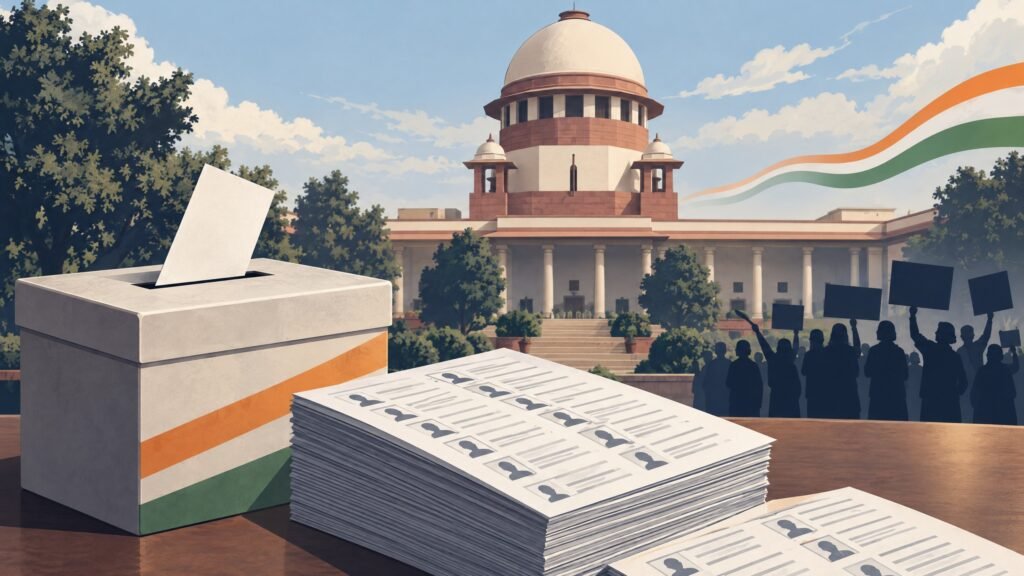
NEW DELHI — A petition led by Congress leader Rahul Gandhi and other opposition figures challenging the Election Commission of India’s Special Intensive Revision (SIR) of voter lists was reported ready for listing before the Supreme Court on October 13, after petitioners corrected 14 defects flagged by the court registry. That is a procedural step, not a hearing or a ruling on the petition’s claims. CNBC-TV18 reported that the plea was ready for listing but did not report that the court had granted any relief. [CNBC-TV18]
The filing follows an opposition march in New Delhi on October 12. Thousands of demonstrators walked about seven kilometres through central Delhi to the Supreme Court and submitted a petition challenging the voter-roll exercise. The march passed peacefully amid tight security, Reuters reported. Authorities closed six metro stations for 11 hours and restricted traffic on several roads. [Reuters]
What the petition asks
According to CNBC-TV18’s account, the petition seeks an interim pause in the SIR process across states while the challenge is considered. It asks for an independent audit of changes to electoral rolls, including deletions, and proposes a committee headed by a retired Supreme Court judge. The petitioners also seek booth-wise lists showing which voters were removed and why. These are requests in the filing, not directions already issued by the court.
The plea asks for safeguards requiring that an elector not be deleted without notice and a reasonable chance to respond. It also seeks disclosure of records related to disputed decisions, including minutes, agendas, official notes and objections. The petition alleges that Chief Election Commissioner Gyanesh Kumar acted without the knowledge or concurrence of the other Election Commissioners. It cites information obtained under India’s Right to Information law and questions whether a formal decision was taken to begin a nationwide SIR in 2025. Those arguments remain allegations for the court to assess.
The filing also challenges changes to Form 6, which is used to apply for inclusion in electoral rolls. It alleges that new applicants were asked to establish whether their parents or grandparents appeared in earlier rolls, without a corresponding change to the governing rules. The petition raises separate concerns about the Election Commission’s ECINET and ERONET databases, alleging they lack an effective way to restore names wrongly removed. The claims are not independent findings, and the legal and technical questions would need to be tested against official records and rules.
Why the revision is disputed
The SIR is an exercise to revise electoral rolls. The Election Commission says its purpose is to identify duplicate or ineligible entries and keep lists accurate. Reuters reported that more than 130 million names had been struck from voter lists in the wider revision, including people recorded as deceased, moved or untraceable. That reported total describes the scale of the exercise; by itself, it does not show that every deletion was wrong or that each affected person remained eligible in that constituency.
That distinction matters to voters. Removing a duplicate entry can improve a list, while removing an eligible person by mistake can prevent that person from voting unless the error is corrected in time. The dispute is therefore also about the verification process: what records officials rely on, whether people are told that their status is at risk, and whether there is a practical way to object before a name disappears from a final roll.
Opposition parties say the process risks excluding eligible voters and have called for greater transparency. Reuters reported that opposition leaders allege Muslim voters and other minority communities may be disproportionately affected. The Election Commission and the Bharatiya Janata Party (BJP) reject allegations of political manipulation. The alleged pattern remains disputed; public statements from political parties do not, by themselves, establish whether the process treated any group unlawfully.
The Election Commission has said wrongly deleted voters can re-enrol, Reuters reported. The BJP has accused its opponents of undermining trust in legitimate electoral processes. Neither statement resolves the petition’s claims. The court may be asked to examine the authority and procedures used for the revision, the records supporting deletions, and the remedies available to voters who say their names were removed in error.
March and wider protests
The October 12 demonstration came after several days of tension in the capital. The Associated Press reported that police detained thousands of activists during a weekend crackdown ahead of the march. Opposition lawmakers and supporters later walked to the Supreme Court and submitted their petition to the Chief Justice. Some demonstrators called for the resignation of Chief Election Commissioner Gyanesh Kumar. Reuters said the march included opposition party members and left-wing student groups and concluded peacefully under heavy security. [Associated Press]
What happens next
CNBC-TV18 reported that the Supreme Court registry flagged 14 filing defects and that the petitioners later corrected them, making the plea ready for listing. Registry clearance is administrative; it does not mean judges have decided the merits. The cited report did not announce a hearing, an interim stay or a final order. Any next step depends on the court listing the matter and deciding what responses or records it needs.
If the case proceeds, questions may include what evidence supports the reported deletions, whether voters received notice and a meaningful opportunity to challenge errors, how quickly corrections can be made, and whether consistent safeguards apply across states. The petitioners’ requests for booth-level data, an independent audit and a nationwide pause remain proposals for judicial consideration, not measures already in force.
For voters, the immediate practical step is to check their own enrolment through official election channels and follow any published revision or claims-and-objections schedule for their area. The Commission’s position is that a person wrongly removed can re-enrol; the petitioners argue that notice and a chance to be heard should come before deletion. Neither general guidance nor political claims replace the official instructions for a particular state or voter.
The central question is how to update electoral rolls while protecting each eligible voter from an erroneous deletion. The scale of the revision, the opposition’s allegations, the Commission’s explanation and the proposed safeguards are all part of a live legal dispute. Until the Supreme Court issues directions or a decision, the parties’ claims should remain clearly attributed, and the correction of filing defects should not be mistaken for a verdict.
Sources: Reuters · Associated Press · CNBC-TV18